
Owning rental properties in Snohomish comes with real financial exposure. Standard homeowners insurance won’t cut it-multifamily properties need specialized protection that covers your unique risks.
At Top Insurance Associates, a Trucordia Business, we help property owners navigate multifamily home insurance in Snohomish to safeguard their investments. This guide walks you through the coverage options, common threats, and practical steps to protect what you’ve built.
What Multifamily Insurance Actually Covers
The DP-3 Foundation for Rental Properties
Multifamily home insurance in Snohomish operates on a completely different framework than the homeowners policy protecting your primary residence. The standard form used for rental properties is called a DP-3, which provides open-peril coverage on the building structure itself-it protects against all risks except those specifically excluded. This covers the walls, roof, floors, and permanent fixtures, but it stops at the tenant’s doorway. Their personal belongings remain entirely their responsibility. A DP-3 also includes fair rental income coverage, which reimburses you for lost rent if the property becomes uninhabitable from a covered loss.
Layered Protection Beyond the Basics
You can add multiple protections onto this foundation to strengthen your position. Legal defense coverage pays your attorney fees if you face a lawsuit related to the rental property, such as a wrongful eviction claim. Loss-of-rent coverage provides income replacement during repairs. Extended dwelling coverage can pay an extra 25 to 50 percent above your standard coverage limit to help with full reconstruction after a catastrophic loss. The policy can also cover additional structures like detached garages or sheds, and owner-supplied equipment such as laundry machines or tools that tenants use.
Why Rental Properties Demand Specialized Coverage
Your financial exposure differs entirely from an owner-occupied home. In Snohomish County, about 37 percent of households rent according to the U.S. Census Bureau, and Washington real estate investors have seen approximately 9.6 percent annual home-price appreciation since 2012, making your equity substantial and worth protecting. Unlike an owner-occupied property where your main concern is personal liability and structure damage, a rental property generates income that vanishes the moment tenants cannot occupy it. A standard homeowners policy simply will not cover that lost rent, nor does it account for your liability as a landlord under Washington’s Residential Landlord-Tenant Act.
The Landlord Liability Gap
If a tenant slips in a common area and sues you, or if water damage from your negligence ruins their belongings, a homeowners policy leaves you exposed. The DP-3 addresses these landlord-specific exposures with appropriate liability limits-typically $500,000 to $1 million in Snohomish-and rent-loss protection. Without it, a single loss can wipe out months of income and deplete your reserves before you can rebuild. Understanding these coverage distinctions sets the stage for evaluating which specific protections matter most for your portfolio.
Building Your Coverage Strategy
Calculate Dwelling Coverage from Reconstruction Cost
Your DP-3 dwelling coverage forms the backbone of protection, but the actual limit you choose determines whether you can truly rebuild after a total loss. Start with reconstruction cost, not market value-this is the price to physically rebuild your structure from the ground up, not what you could sell it for. In Snohomish County, multifamily properties with DP-3 coverage typically carry dwelling limits between $250,000 and $500,000, though valuations vary significantly by age, construction type, and location. A pre-1970 wood-frame building costs more to insure and may face surcharges unless retrofitted with modern electrical and sprinkler systems. Distance to a staffed fire station swings costs by up to 30 percent, so a property near downtown Snohomish pays less than one in a rural area. A professional appraisal prevents costly mistakes-underinsuring triggers co-insurance penalties that reduce your payout, while overinsuring wastes premium dollars. Extended dwelling coverage adds 25 to 50 percent above your base limit for an extra cost, and this buffer matters when reconstruction costs spike after a major event. Washington real estate has appreciated roughly 9.6 percent annually since 2012, so your replacement costs grow faster than many owners realize.
Protect Your Personal Assets with Liability and Legal Defense
Liability and legal defense coverage protect your personal assets when something goes wrong on the property. Standard DP-3 policies include liability limits, but Snohomish County landlords should carry $500,000 to $1 million given Washington’s plaintiff-friendly environment-the Insurance Information Institute reported an average premises liability verdict of $2.78 million statewide in 2023. Legal defense coverage pays attorney fees for wrongful eviction claims, discrimination disputes, or tenant injury lawsuits, which is invaluable when facing complex landlord-tenant disputes. Loss-of-rent coverage reimburses your income if the building becomes uninhabitable after a covered loss, typically covering 12 to 24 months depending on your policy. This matters enormously in Snohomish’s competitive rental market-even a two-week vacancy from water damage costs thousands in lost revenue.
Add Coverage for Structures and Equipment
Additional structures like detached garages and owner-supplied equipment such as laundry machines or tools also warrant coverage limits. Umbrella liability policies layer extra protection above your DP-3 limits; for portfolios above $50 million, layered coverage often yields 5 to 8 percent premium reductions. Multiple carriers offer different combinations of these protections at varying price points, so comparing quotes across several insurers reveals which combination fits your property and budget best.
What Threatens Your Snohomish Rental Property
Seismic and Weather Risks in Snohomish County
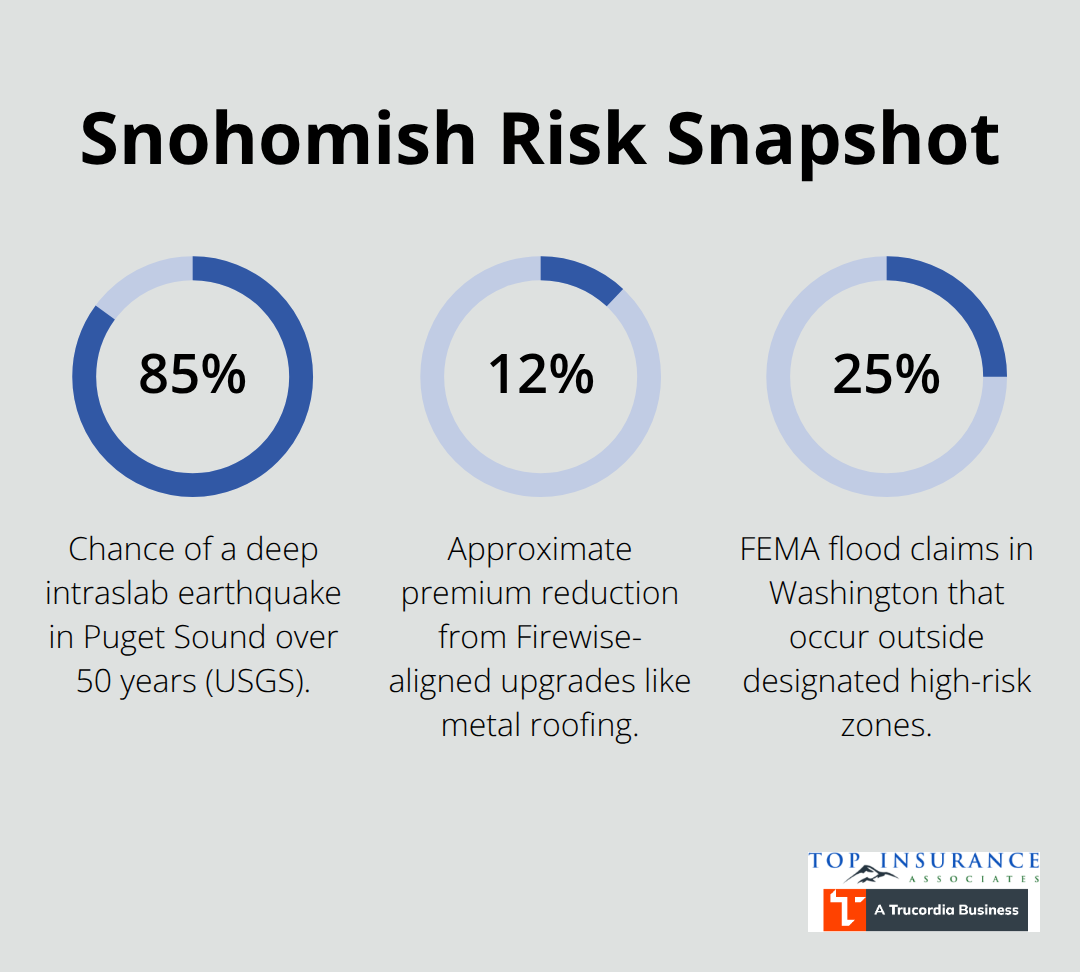
Snohomish County sits in one of America’s most geologically active regions, and weather patterns here test rental properties relentlessly. The USGS indicates an 85-percent chance of a deep intraslab earthquake in the Puget Sound region in the next 50 years, making seismic risk real for your investment. Wildfire exposure is rising too-insurers increasingly require Firewise-compliant improvements, and properties that adopt metal roofing or flame-resistant landscaping can reduce premiums by around 12 percent. Water damage from heavy rains and sewer backup remains the most frequent claim type in Western Washington; about 25 percent of FEMA flood claims in Washington originate outside designated high-risk zones, meaning your Snohomish property faces flood exposure even if you’re not near a riverbank.
Coverage Gaps for Natural Disasters
Standard DP-3 policies exclude flood and earthquake coverage entirely, so these protections demand separate endorsements or standalone policies. A sewer and drain backup endorsement costs little but covers water intrusion from infrastructure failures during heavy precipitation-essential in the region’s wet climate. Earthquake coverage carries deductibles of 10 to 20 percent of your dwelling limit and can cost $60 to $200 annually depending on location; Puget Sound properties pay more due to Cascadia fault proximity. For higher-value assets, excess flood policies go beyond NFIP’s $250,000 residential structure cap, and parametric flood coverage is gaining traction for rapid payouts when trigger conditions are met rather than waiting for adjuster assessment.
Tenant Liability and Slip-and-Fall Exposure
Tenant-related claims and liability exposures hit your bottom line faster than you might expect. A slip-and-fall lawsuit in a common area or a negligence claim over water damage to tenant belongings can escalate to six figures in legal fees and settlements before your case concludes. The Insurance Information Institute reported an average premises liability verdict of $2.78 million statewide in 2023, underscoring why $500,000 to $1 million liability limits are not excessive for Snohomish multifamily properties.
Vacancy and Theft Risks
Vacancy creates another serious exposure-after 60 consecutive days without occupancy, standard DP-3 policies exclude vandalism, water damage, and theft unless your carrier approves the vacancy in writing and charges extra premium. A 2021 claim study found 18 percent of fire losses were denied due to vacancy violations, so notification and documentation matter enormously. Theft and vandalism claims spike during extended vacancies or property transitions between tenants. Maintain active utilities, conduct regular inspections, secure all entry points, and document every visit with photos and timestamps to demonstrate active management. If you anticipate vacancy, notify your insurer beforehand-the small additional premium beats a denied claim by thousands of dollars.
Construction Age and Underwriting Surcharges
For older wood-frame buildings common in Snohomish, pre-1970 construction often carries underwriting surcharges unless the property has been retrofitted with modern electrical wiring and sprinkler systems, so budget for these improvements as part of your overall risk management strategy.
Final Thoughts
Protecting your multifamily home insurance in Snohomish requires more than selecting a policy off the shelf. You need an agent who understands local risks, compares options across multiple carriers, and adjusts your coverage as your portfolio grows. We at Top Insurance Associates, a Trucordia Business, work with property owners throughout Snohomish to build customized strategies that match your actual exposure and budget.
Start by gathering your property details: reconstruction cost, current dwelling limits, liability exposure, and any recent claims or losses. Bring this information to your agent and request quotes on DP-3 policies with $500,000 to $1 million liability limits, fair rental income coverage, and sewer backup protection. Request quotes that include earthquake and flood endorsements so you understand the true cost of comprehensive protection-many owners are shocked to discover that adding earthquake coverage costs only $60 to $200 annually depending on location.
Once you have a policy in place, review it annually since property values in Snohomish have appreciated roughly 9.6 percent per year since 2012, which means your reconstruction costs have climbed faster than most owners realize. Maintain a room-by-room video inventory with cloud storage, keep purchase receipts for owner-supplied equipment, and photograph the property condition quarterly so this evidence accelerates claims when a loss occurs. Contact Top Insurance Associates, a Trucordia Business for a no-obligation quote and policy review tailored to your Snohomish rental portfolio.
Disclaimer: The information provided in this blog is for general informational purposes only and does not constitute legal, financial, or insurance advice. Coverage options, terms, and availability may vary. Please consult with a licensed professional for advice specific to your situation. Artificial intelligence may have been used to generate text and images in some blog articles.