
Owning rental property in the Seattle metro area comes with real financial exposure. Most landlords discover they’re underinsured only after a tenant injury or property damage claim hits.
We at Top Insurance Associates, a Trucordia Business help Seattle metro landlords build coverage that actually protects their investment. This guide walks you through the specific Seattle metro rental insurance policies that matter most.
What Landlord Insurance Actually Covers
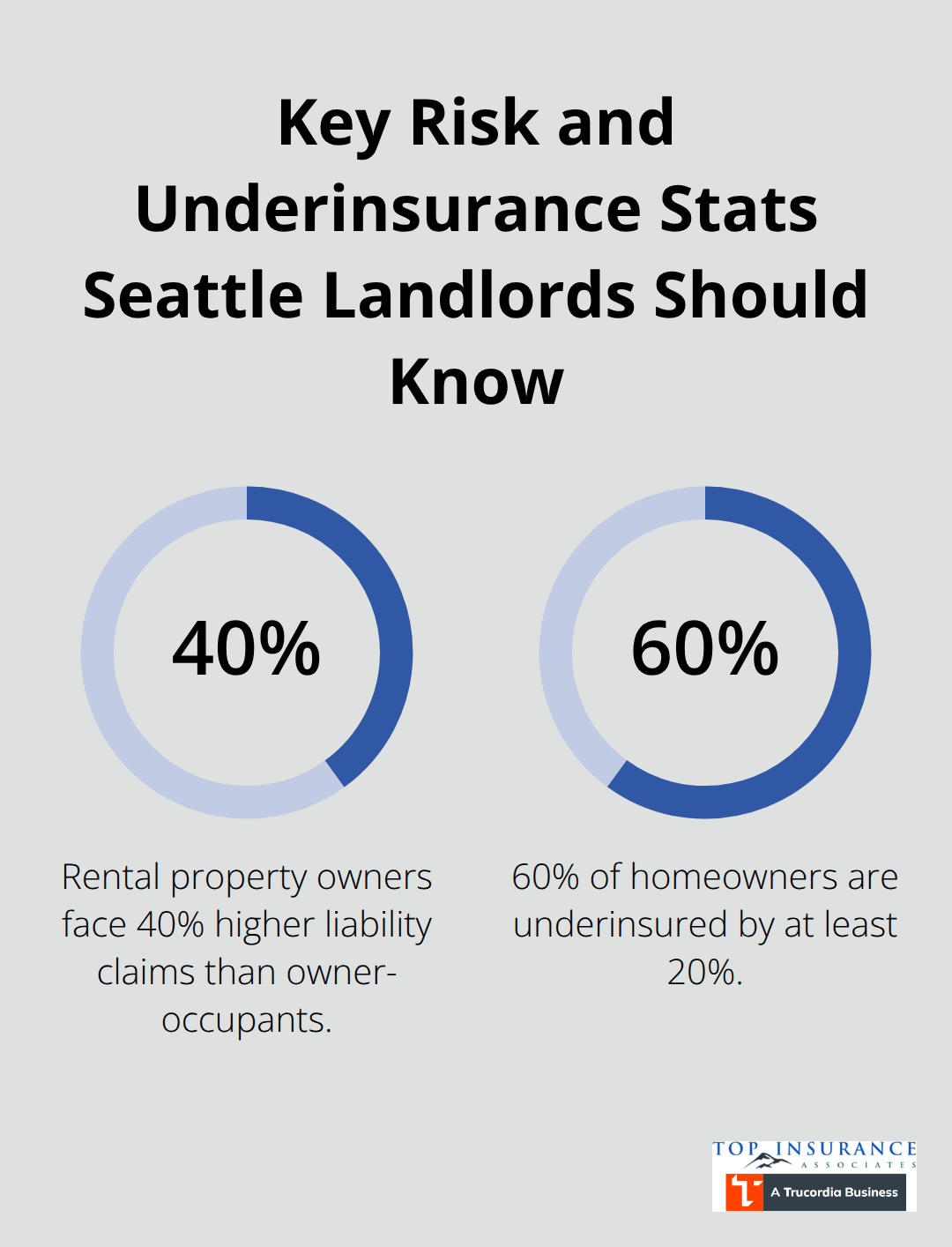
Landlord insurance isn’t a minor upgrade to homeowners coverage-it’s a fundamentally different product built for income-generating properties. Standard homeowners policies explicitly exclude rental units because insurers recognize that tenant-occupied properties face different risks than owner-occupied homes. When you rent out a property in the Seattle metro area, you need coverage that acknowledges this reality. Landlord policies protect the building structure, your liability exposure from tenant injuries, and your lost rental income if the property becomes uninhabitable. The National Association of Insurance Commissioners reports that rental property owners face 40% higher liability claims than owner-occupants, which is why carriers price and structure landlord policies separately. This coverage matters because a single tenant injury lawsuit can exceed $500,000 in damages in Washington state-far beyond what your homeowners policy would cover.
Why Standard Homeowners Policies Fail Rental Properties
Most landlords assume their homeowners policy extends to rental units, then discover during a claim that it actually doesn’t. Your homeowners policy covers your residence and personal liability-not business operations or tenant-related exposures. If a tenant’s guest suffers injury on your rental property in Tacoma or Everett, your homeowners insurer will deny the claim outright. Loss of rental income isn’t covered under homeowners policies either, which means a fire or major damage leaves you with no income stream while repairs happen. Washington state landlords who’ve faced this gap report losing $3,000 to $8,000 monthly in rental income during property repairs-money they had to cover themselves.
Landlord policies fill these gaps directly, covering the building itself, liability for injuries that occur on the property, and your lost rent if tenants must vacate temporarily.
Coverage Gaps That Cost Seattle Metro Landlords Money
Even landlords with landlord insurance often miss critical protections that create expensive blind spots. Many policies don’t cover damage from tenant negligence-only sudden, accidental damage-which leaves you exposed if a tenant causes a fire or water damage through carelessness. Short-term rental properties, increasingly common across the Seattle metro, require specialized coverage that standard landlord policies don’t provide; standard landlord policies assume long-term tenants with leases. Liability coverage limits of $100,000, which many landlords think is adequate, fall short in a single serious injury case where medical costs and legal fees combine quickly. Most Seattle metro rental properties need minimum liability limits of $300,000, with $500,000 for multi-unit buildings. Additional living expense coverage often comes with low limits-$10,000 or $15,000-which barely covers one month’s temporary housing costs in the Seattle area where rental prices run $1,500 to $2,500 monthly for a modest unit.
What Happens When Coverage Mismatches Reality
The gap between what landlords think they’re covered for and what their policies actually pay shows up during claims, not during the application process. A tenant injury claim, property damage from weather, or unexpected vacancy can expose these holes quickly. Top Insurance Associates, a Trucordia Business helps Seattle metro landlords identify these gaps before they become expensive problems. The next section walks through how coverage needs shift across different Seattle metro communities, from Everett to Tacoma to the eastern suburbs.
Rental Property Coverage Across Seattle Metro Communities
Everett and North King County: Weather Exposure and Higher Property Values
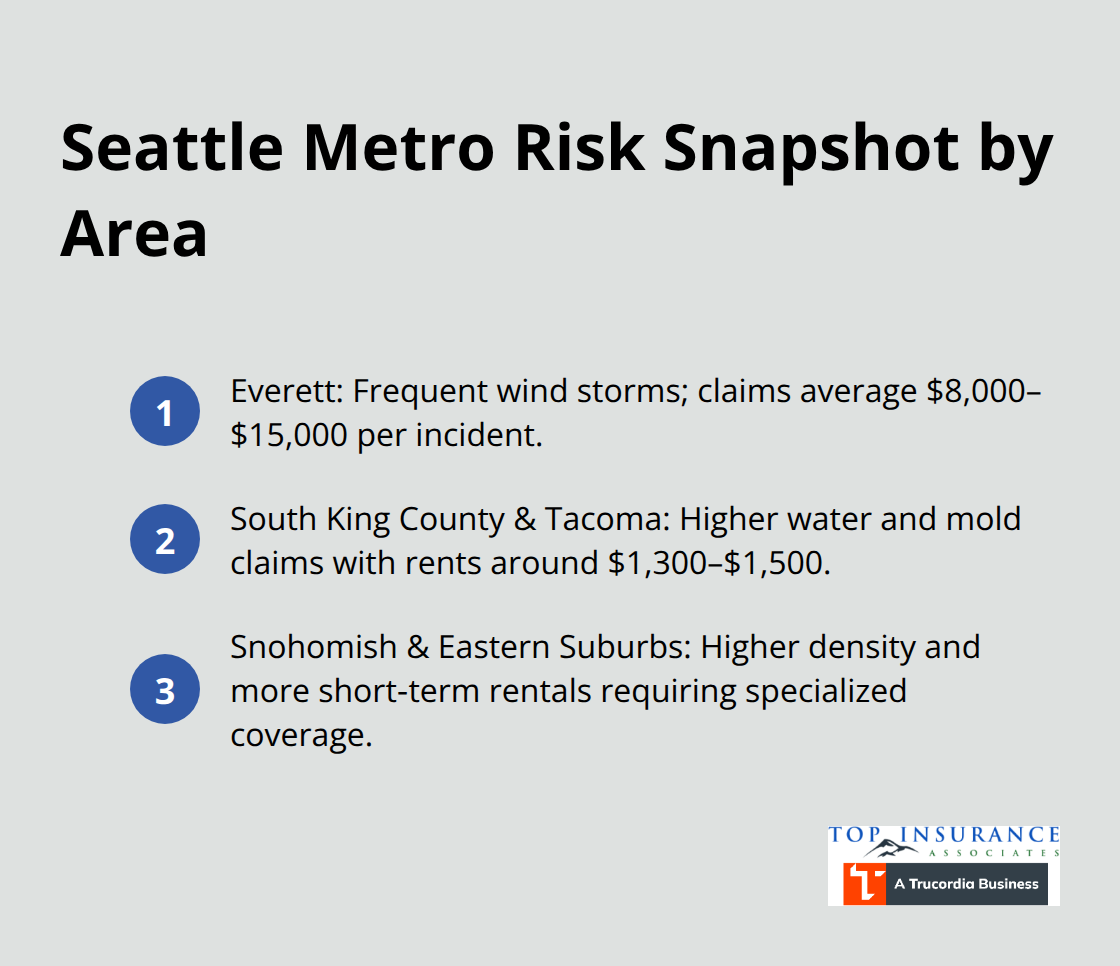
Everett’s rental market centers on single-family homes and small multi-unit properties, with average rents between $1,600 and $1,800 monthly. Properties in this area face substantial wind and weather-related damage claims, particularly during fall and winter storms that regularly impact the Puget Sound region. Rental property wind damage claims in Everett average $8,000 to $15,000 per incident, so underestimating replacement costs creates serious gaps when storms strike. Your building coverage must reflect this exposure directly.
North King County areas like Shoreline and Edmonds experience similar weather patterns but command higher property values. A modest three-bedroom home in these communities costs $400,000 to $550,000, which means your dwelling coverage must account for full reconstruction at current Seattle metro labor and material rates. Outdated valuations leave you significantly underinsured when damage occurs. Liability exposure also differs here because these neighborhoods attract higher-income tenants who pursue legal action more aggressively after injuries, making $300,000 minimum liability limits essential rather than optional.
South King County and Tacoma: Water Damage and Tenant Turnover
South King County and Tacoma present an entirely different risk profile from North King County. Rental properties here rent for $1,300 to $1,500 monthly, attracting price-sensitive tenants who report maintenance issues less frequently, which increases your exposure to preventable damage. Properties in these areas show higher rates of water damage and mold claims compared to North King County, largely because older housing stock and aging plumbing systems dominate the rental inventory. Landlords in Tacoma and Kent consistently underestimate water damage coverage limits-you need minimum additional living expense coverage of $20,000 in these areas where tenant turnover runs higher and vacancy periods stretch longer.
Snohomish County and Eastern Suburbs: Density and Short-Term Rentals
Snohomish County and eastern suburbs like Lynnwood and Bothell demand different considerations entirely. These communities feature more newer construction with better building codes, which reduces structural damage risk but increases liability exposure from higher tenant density in apartment complexes. Multi-unit properties in these areas require specialized coverage addressing shared liability, common area maintenance, and higher loss-of-rent exposure if a single incident affects multiple units simultaneously.
Eastern suburbs also attract more short-term rental activity, which standard landlord policies explicitly exclude. You’ll need specialized short-term rental coverage with different underwriting and higher premiums than traditional long-term rental policies command. This coverage gap matters significantly because short-term rental properties operate under fundamentally different tenant relationships and turnover patterns than long-term leases. The next section examines the specific coverage types that protect your investment across all these Seattle metro communities.
Essential Coverage Types for Seattle Metro Landlords
Building Coverage That Matches Actual Reconstruction Costs
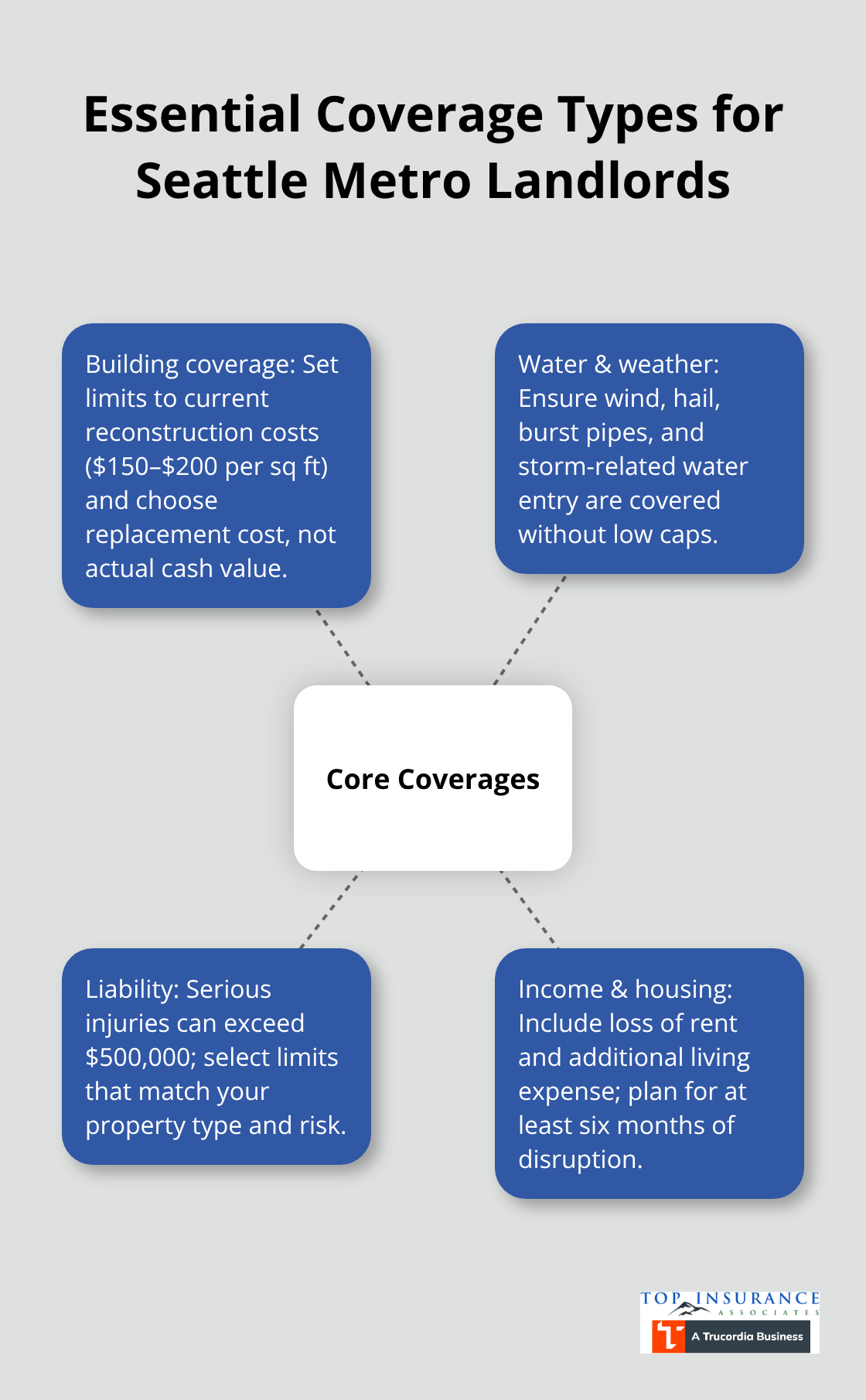
Building coverage must reflect what it actually costs to rebuild your property today, not what you paid for it years ago. Seattle metro construction costs run $150 to $200 per square foot for standard residential rebuilds, which means a 2,000-square-foot rental home needs minimum dwelling coverage of $300,000 to $400,000 just for the structure itself. Many landlords set coverage limits based on their mortgage balance or purchase price-a critical mistake that leaves them dramatically underinsured when damage strikes.
The Insurance Information Institute reports that 60% of homeowners nationwide are underinsured by at least 20%, and rental property owners face even worse odds because they often neglect regular coverage reviews as property values and construction costs climb. You need replacement cost coverage, not actual cash value, which means the insurer pays what it costs to rebuild today rather than subtracting depreciation. Actual cash value policies often do not pay enough to fully replace your property or repair the damage.
Water and Weather Damage Protection
Water damage and weather-related claims dominate Seattle metro rental claims, so your building policy must explicitly cover wind, hail, and water damage from storms. Some carriers exclude water damage from certain causes or cap payouts at levels that don’t cover modern remediation costs for mold and water intrusion. Verify your policy covers water damage from burst pipes, ice dams, and storm-related water entry without arbitrary caps that stop short of full restoration costs.
Liability Coverage for Tenant-Related Injuries
Liability coverage protects you when a tenant’s guest or the tenant themselves suffers injury on your property and pursues legal action. A single serious injury case in Washington state routinely generates medical expenses exceeding $100,000, combined with legal fees and court awards that push total liability exposure well past $500,000. Standard liability limits of $100,000 or $300,000 become inadequate instantly when a guest suffers a fall, burn, or other injury that requires ongoing medical care.
Minimum liability limits of $500,000 for single-unit properties and $1,000,000 for multi-unit buildings in the Seattle metro cost only marginally more than lower limits but protect against catastrophic financial exposure. This coverage difference matters significantly when you face a serious claim.
Loss of Rental Income and Temporary Housing Coverage
Loss of rental income coverage compensates you for rent you cannot collect when tenants must vacate due to damage covered by your policy. If a fire makes your Tacoma rental uninhabitable and repairs take four months, you lose $5,200 to $6,000 in monthly rent with no income to offset that loss unless your policy includes this coverage. Most landlords dramatically underestimate how long repairs actually take and set coverage limits far too low.
Additional living expense coverage pays for temporary housing costs if tenants must relocate during repairs, which in the Seattle metro easily runs $2,000 to $3,500 monthly for suitable temporary housing. Set these limits based on actual market rent in your specific community, not generic assumptions about what housing costs. Your policy should cover at least six months of lost rent and temporary housing costs to handle extended rebuilds that modern damage claims frequently require.
Final Thoughts
Your Seattle metro rental property represents a significant financial asset that demands protection matching its actual value and risk exposure. The coverage gaps we’ve outlined across Everett, Tacoma, Snohomish County, and surrounding communities show that generic landlord policies fall short of what your specific situation requires. Building coverage that reflects current reconstruction costs, liability limits that handle serious injury claims, and loss of rental income protection that covers extended repair periods aren’t optional upgrades-they’re foundational requirements for responsible property ownership in this region.
Finding the right Seattle metro rental insurance policy requires more than comparing premium quotes online. Your property’s age, construction type, tenant profile, and location within the metro area all shape what coverage you actually need. A three-bedroom home in Shoreline faces entirely different risks than a multi-unit complex in Lynnwood, which means your policy structure must reflect those differences rather than forcing your property into a one-size-fits-all template.
We at Top Insurance Associates, a Trucordia Business work with Seattle metro landlords to compare options across multiple carriers and find coverage that protects your investment without overpaying for unnecessary add-ons. Our team handles policy reviews, answers questions about coverage gaps, and supports you through claims when damage occurs. Connect with our local agents who can build a tailored policy matching your specific property and risk profile by visiting Top Insurance Associates, a Trucordia Business today.
Disclaimer: The information provided in this blog is for general informational purposes only and does not constitute legal, financial, or insurance advice. Coverage options, terms, and availability may vary. Please consult with a licensed professional for advice specific to your situation. Artificial intelligence may have been used to generate text and images in some blog articles.